

The Glue Talk Blog
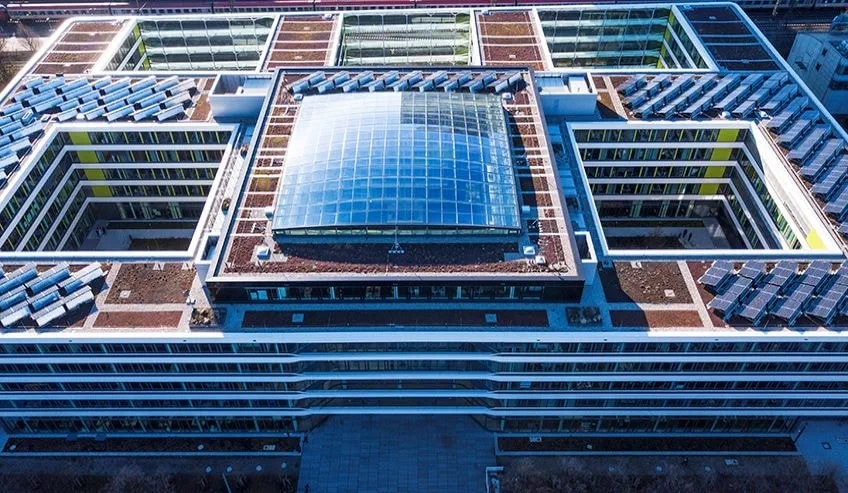
Property developers and employers are increasingly investing in innovative real estate projects that sensibly combine New Work and Zero Waste concepts. A prominent example of such a super-efficient and attractive construction project is the NEWTON in Munich’s Westend, an office property from the TÜV SÜD Group Munich, completed in 2018. What makes its ultra-modern façade stand out, among other things, are the sophisticated cold-bent, double-curved insulating glass units in the roof dome. To ensure that these meet the high demands for reliable edge-sealing and long-lasting stability, the ultra-high-performance Ködispace 4SG warm edge system from adhesive and sealant manufacturer H.B. Fuller | KÖMMERLING was used.
In recent years, Munich’s Westend has increasingly developed into a popular residential and nightlife area. The successful mix of old and new buildings, small pubs and popular restaurants, as well as the short distances to local recreation areas in and around Munich, make this new trendy neighbourhood especially attractive. At the same time, a progressive business location has become established, and in addition to the well-known ADAC Tower, the Fraunhofer Institute and other renowned institutions, now boasts The NEWTON as its latest real estate project from the TÜV SÜD Group. In The NEWTON, a total of close to 35,000 m² of office space in 65 occupancy modules offer ideal conditions for new, forward-looking work environments accommodating up to 2,000 people. The glass-roofed hall forms the main focal point of the building and a forum for events. GEWE-therm 4SG insulating glass from SCHOLLGLAS were used to build the roof dome in The NEWTON. After production and delivery to the construction site, the insulating glass units were bent directly on site by experts from LAMILUX using an assembly and bending method that firstly fixes them to the frame construction diagonally, and then into their final shape. All edges of the 1,850 x 1,850-millimeter insulating glass units are held in a linear manner using pressure bars and have a maximum corner deflection of 95 millimetres.

In the NEWTON’s double-curved roof dome, the flexible warm edge system with Ködispace 4SG ensures that the cold-bent insulating glass is permanently sealed.
In order to meet the high demands for reliable sealing and long-lasting stability, the building materials and composites used for the construction of The NEWTON were extensively tested in advance. First and foremost, the structural integrity of the Ködispace 4SG spacer system for the glass structure in the roof dome was evaluated. To compare the double-glazed insulating glass units to be installed, two digital models were created: one with a Ködispace 4SG spacer system and one with a conventional aluminium spacer. Both models were then examined in detail within the framework of a finite element analysis (FEA) assessing the shear loads in the edge compound system of the planned roof dome caused by the consequent deformation from the bending.
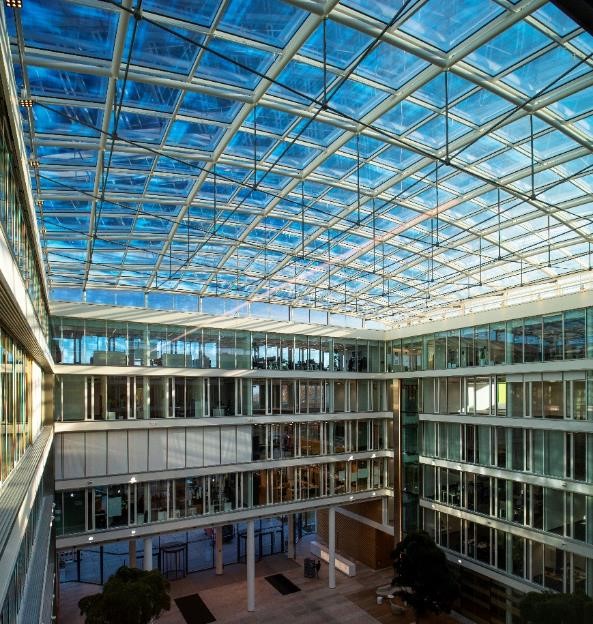
The NEWTON’s glass-roofed hall is a main focal point of the building, entrance for the working world of up to 2,000 people as well as a forum for events.
The results clearly showed that, especially with cold-bent insulating glass units, the Ködispace 4SG reactive warm edge system has clear advantages over a conventional spacer bar system. This confirmed that stiffer conventional spacers cannot compensate for the resulting loads for two primary reasons. Firstly, inflexibility of the material, and secondly, almost all of the shear load relies on absorption through a very thin PIB (butyl primary sealant) layer, often measuring less than 0.5 millimeters. These factors lead to deformations of the primary seal, which could lead to leaks.
Due to significantly more flexible behavior, Ködispace 4SG absorbs the external deformation without creating significant stresses. Ködispace 4SG also uses the entire width and volume of the spacer it creates between the panes – depending on the system this is normally 12 to 20 millimeters compared to two 0.3 to 0.5-millimeter PIB layers in conventional systems – and is able to compensate for the occurring loads and associated deformations compared to a conventional, rigid spacer system. With Ködispace 4SG, the resulting deformations are smaller by a factor of about 10 in the case detailed above. Additionally, greatly improved gas tightness is achieved with the reactive polyisobutylene chemically bonding to both the glass surface and the silicone secondary sealant. As a result, the entire edge seal “blends” into a flexible and resilient unit that is permanently tight and stable over the long term. This and the final results of the FEA were confirmed by component tests: data that ultimately convinced both the planning parties and The NEWTON façade builders of H.B. Fuller | KÖMMERLING’s system.
When building The NEWTON, long-term thinking coupled with responsible and sustainable design principles were top priorities for the team of architects at DMP, a member of the German Sustainable Building Council since 2008. In addition to the use of intelligent and innovative building materials, the building also stands out with an ecological concept that works with existing resources. Regardless of the season, the building is heated or cooled continuously with groundwater. Moreover, photovoltaics on the roof surfaces enable the use of regenerative solar power, reducing the general electricity requirement by a further 25 percent. The energy requirement itself is also impressive: with a primary energy requirement of approx. 72 kWh/m²a, The NEWTON achieves an absolute peak value, almost a third less than the average for an office building of comparable size. The use of the Ködispace 4SG warm edge system in the construction of the roof dome makes a significant contribution to sustainable construction, as long-term energy-efficient insulating glass units can only be achieved in combination with permanently gas-tight spacer systems. The prudent approach of all those involved in designing the environmental strategy for the building was recently rewarded with a DGNB platinum certificate awarded for a sustainable building performing at the highest award level. This puts The NEWTON in the top rankings of Munich’s desirable office properties.
Blog Categories
Blog Categories
Archive
-
2026
-
January (5)
- Elevating Performance: How H.B. Fuller Powers the Future of Elevator Manufacturing
- Navigating EPR Legislation in the U.S.: How Adhesives and Packaging Can Meet Regulations
- Powering the Future: The Growth of New Energy Storage
- Setting the Record Straight: Why Roof Coatings Are a System, Not a Shortcut
- Strategic Partnerships are Reshaping Roofing Distribution—Here’s How H.B. Fuller Helps you Stay Ahead
- February (5)
-
March (5)
- Adhesives and Recyclability: Why They Matter
- Flexible Packaging Trends for 2026: From Momentum to Maturity
- Recycling Day: How Innovation and Responsibility Are Transforming the Future of Materials
- Why RRO Expertise Matters in Delivering Better Roofing Solutions
- Winter Tips for Using Roofing Adhesives
-
April (6)
- From Steam to Sustainable
- How Minnesota is Advancing H.B. Fuller’s Next Chapter of Global Growth
- How Spray Applied Canister Adhesives Help Roofing Contractors Overcome Global Labor Shortages
- Luxury Yacht Trends Meet Advanced Bonding Technologies
- More Than a Sealer: Introducing Lash Fuser Smart Bonding Technology
- Navigating Packaging Trends and Challenges: Advantra® Earthic™ 9500 as the Game-Changing Solution
-
May (5)
- A Buyer’s Guide to Flame-Retardant Foams
- ASC 2026 Insights: Sustainable Adhesives & Award Winning Innovation
- New Partners and Superstar Volunteers—See How H.B. Fuller is Making an Impact
- Sesame® Handle System: A Gripping New Product Years in the Making
- The Growing Importance of Masking Tapes Across Industries and How Gel-Tac™ Masking Delivers Reliable Results
- June (4)
- July (2)
-
August (6)
- Choosing the Right Adhesive: Electronic Applications
- How Adhesives and Sealants are Used in Glass Windows
- Choosing the Right Adhesives for Packaging Applications
- H.B. Fuller Company Foundation Announces First Global Grantmaking Partners
- RV Industry Trends 2026: Meeting Manufacturing Challenges with Adhesive & Sealant Technology
- What We Learned About Gen Z Beauty Buying Behavior
-
September (7)
- A Guide to Bonding Agents
- From Design to Recycling: How Adhesives Impact Paper and Board Packaging
- H.B. Fuller’s R&D Research Fellowship Driving Innovation and Business Impact
- 6 Best Practices for Engineered Wood Manufacturing
- Three Ways to Ensure Beauty Adhesives Meet Safety Standards
- Understanding DIY Lash Adhesive Ingredients: What's Really Behind the INCI List?
- Vacuum Infusion: The Critical Role of Sealing, Material Positioning and Process Reliability
-
October (4)
- How Beverage Brands Are Reducing Plastic with Smarter Multipack Solutions
- Leading Through Innovation: How Huhtamaki and Bin Dasmal Group Are Creating Solutions for Tomorrow
- Navigating EPR Legislation in the U.S.: What Producers and Packaging Partners Need to Know
- When Vapor Barrier Performance Matters: Protecting Insulated Systems from Moisture Intrusion
-
January (5)
-
2025
- January (4)
- February (5)
-
March (5)
- Celebrating Women in Science on International Women’s Day
- Choosing the Right Adhesives and Sealants for Automotive Applications
- Debonding on Demand in Electric Vehicle Batteries: The Future of Efficient Recycling and Reuse
- Domestic Production & Tax Credits: The IRA’s Impact on Solar Manufacturing
- Why We Say Cosmetic Adhesives – The Science Behind Beauty Formulations
- April (2)
-
May (7)
- Auto Dilution System (ADS) for Enhanced Performance in Tissue and Towel Manufacturing
- Beauty Adhesives in Europe
- Benefits of Using Thermally Conductive Adhesives and Encapsulants in Li-Ion Batteries
- Innovation Through Collaboration: H.B. Fuller’s Customer Innovation Awards Winners
- H.B. Fuller Expands Manufacturing Capabilities in IMEA Region
- Talking Beauty Chemistry - How to Simplify and Communicate
- Top Consumer Trends Shaping the Tissue and Towel Product Market
- June (4)
-
July (9)
- Barrier Coatings for Paper-Based Food Packaging: A Guide to Compliance and Performance
- Can Lash Adhesives Work in Low Humidity
- Choosing the Right Adhesive: Hygiene
- H.B. Fuller Advances Commercial Roofing with Millennium PG-1 EF ECO₂
- How Advanced Adhesives Help Companies Thrive In The Circular Economy
- How Innovative Adhesive Technology and Manufacturing Practices Drive Sustainability
- Label Adhesives at a Crossroads: Meeting the Demands of a Sustainable, High-Performance Future
- Smarter Bonding as a Secret Weapon for Improving Industrial Assembly
- Stick Smart: Why Clean Removal and Easy Adhesion Matter in DIY Wall Décor
- August (3)
- September (3)
-
October (6)
- 2025 Global Trends in the Disposable Hygiene Industry
- Launching Fuller Impact: A New Era in Supporting Global Communities
- Lightweight Adhesives for EV Manufacturing: Reducing Weight, Improving Range
- Make a Difference 2025
- The Hidden Expense of Low-Cost Butyl
- The Role of Adhesives in Next-Gen Renewable Energy Storage Solutions
-
November (6)
- From Solar Panels to Recycled Water: Driving Sustainability and Business Impact in Colombia
- Electrifying the Future: 2026 Trends in Bus Manufacturing and H.B. Fuller’s Role in Sustainable Innovation
- Engineered Wood Adhesives Guide
- India’s Two- and Three-Wheeler Market: Accelerating Toward an Electric Future
- Three Emerging Trends in the Water-based Polymers Industry
- Where Science Meets Skin: H.B. Fuller Powers STEM Learning at the Science Museum of Minnesota
- December (2)
-
2024
- January (1)
- March (1)
- April (1)
- May (2)
- June (2)
-
July (5)
- Emerging Trends in Commercial Roofing and the Pivotal Role of Adhesives
- How Adhesives Advance Eco-Friendly Food Packaging
- How to Build the Beauty Brand of Your Dreams
- Sustainability Terminologies: A Journey Into the Words that Define Environmental Impact
- The Power of Silicone Adhesives and Sealants in Solar Panel Applications
- August (4)
- September (4)
- October (1)
- November (4)
- December (4)
- 2023
-
2022
- February (4)
- March (3)
- April (1)
- May (2)
- June (4)
-
August (6)
- Beverage Labeling Market in Africa: Key Trends, Opportunities, and Innovations
- H.B. Fuller’s Glue House: Scavenger Hunt
- Increasing Global Aging Population: Impacts and Challenges
- Innovations and Key Challenges in Sustainable Disposable Absorbent Hygiene Products
- Supporting Racial Equity in Our Community
- Top 5 Reasons to Invest in H.B. Fuller
- September (4)
- November (2)
- December (2)