
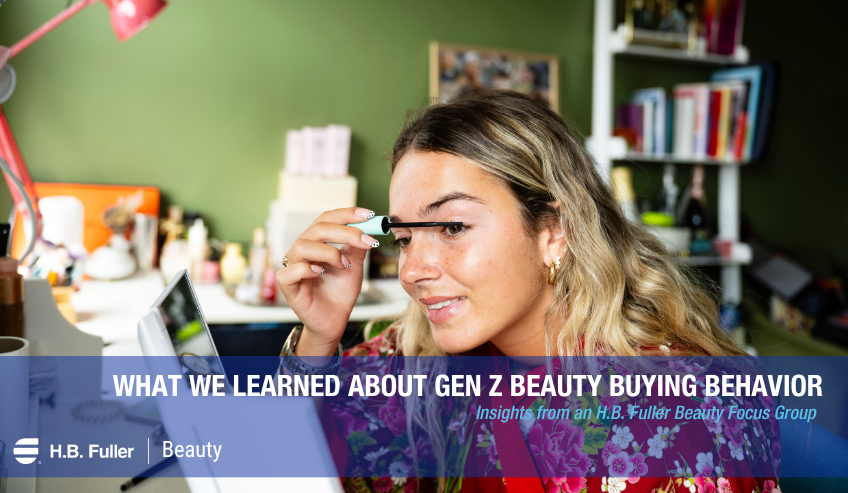
What We Learned About Gen Z Beauty Buying Behavior
Posted 10 8月 2026 by Melissa Seburg, Business Development Manager Beauty
In the beauty industry, trends move quickly, but understanding the motivations behind consumer decisions is often far more valuable than following the latest viral product.
To better understand how younger consumers evaluate beauty products, H.B. Fuller Beauty recently conducted a Gen Z focus group discussing false lashes, press-on nails, adhesives, ingredients, social media, and brand trust. While these findings are directional rather than statistically representative, the discussion revealed several themes that may help beauty brands better connect with the next generation of consumers.
Performance Wins Every Time
One of the clearest themes throughout the discussion was that product performance remains the most important factor in purchase decisions.
For false lashes, concerns centered around comfort, durability, and ease of application. For press-on nails, long-lasting wear and dependable adhesion were key priorities.
Interestingly, participants often discussed ingredients, sustainability, and brand values but these factors generally became meaningful only after the product met their performance expectations.
Consumers Want Simplicity, Not Complexity
Many participants expressed hesitation around false lashes - not because they disliked the end result, but because the application process felt intimidating. Common concerns included:
Fear of damaging natural lashes
Difficulty applying adhesive correctly
Uncertainty about durability
Poor fit for different eye shapes
Similarly, press-on nail users emphasized that proper preparation, fit, and application significantly affected product performance.
The takeaway for brands is clear: simplifying the user experience may be just as important as improving the product itself.
Education Builds Confidence
One of the strongest opportunities identified during the focus group was education.
Participants repeatedly highlighted the value of:
Application tutorials
Ingredient explanations
Product demonstrations
Videos featuring scientists or technical experts
Guidance on safe application and removal
Many suggested that brands provide QR codes directly on packaging linking to instructional content. Several participants stated that they would rather watch a one-minute video than read written instructions.
For brands, educational content is not simply a marketing tool - it can help reduce barriers to purchase and improve the overall consumer experience.
Ingredient Transparency Matters - But Context Matters More
Ingredient discussions revealed an interesting nuance.
Participants often associated shorter ingredient lists with safer products and viewed claims such as "cruelty-free" and "vegan" positively. However, they also emphasized that simply listing ingredients is not enough. What they really wanted was an explanation of what ingredients do and why they are included.
The group viewed educational content explaining ingredient functionality as significantly more valuable than fear-based messaging that attempts to create concern about specific chemicals. Participants noted that overly alarmist marketing can actually reduce trust.
For brands, this presents an opportunity to shift the conversation from ingredient fear to ingredient understanding.
Trust Looks Different for Gen Z
When discussing sources of information, participants overwhelmingly pointed to:
TikTok
Instagram
YouTube
Product reviews
Friends and family recommendations
Brand-owned channels were generally viewed as less trustworthy than authentic third-party experiences. Before making purchases, participants often researched products through reviews, demonstrations, comments, and user experiences.
The most trusted content included:
Micro-influencers
Relatable creators
Educational content
Expert explanations
User-generated content
Perhaps surprisingly, highly polished advertising was often viewed with skepticism. Lower-production, authentic content frequently generated higher levels of trust.
Authenticity Matters More Than Perfection
Participants consistently associated trust with transparency.
Brands were viewed more favorably when they:
Explained their ingredients
Responded to customer questions
Showed real product experiences
Maintained consistent messaging
Demonstrated clear values
Several participants even noted that seeing a mix of positive and negative reviews increased credibility because it felt more authentic.
In an era where consumers are constantly exposed to marketing messages, authenticity appears to be a significant differentiator.
Sustainability Isn't Always the Purchase Driver
While participants generally appreciated sustainability efforts, sustainability was rarely identified as a primary reason for purchasing beauty products.
Instead, discussions suggested that sustainability messaging is most effective when it reflects a genuine company value rather than a standalone marketing campaign. Participants were often skeptical when sustainability appeared disconnected from the broader brand strategy.
For many participants, performance and price remained the primary decision drivers.
What This Means for Beauty Brands
Our focus group highlighted a simple but important insight: consumers are looking for products that work, brands they can trust, and content that helps them feel informed and confident.
For beauty brands, opportunities may include:
Simplifying application experiences
Investing in educational content
Providing ingredient explanations rather than ingredient lists alone
Leveraging authentic content and demonstrations
Building trust through transparency and consistency
Designing products and packaging that reduce user frustration
At H.B. Fuller Beauty, we believe adhesive innovation extends beyond product performance. Helping brands create products that are easy to use, easy to understand, and easy to trust can be just as important as the adhesive itself.