
How Adhesives and Sealants are Used in Glass Windows
Posted 21 8月 2026 by Michael Speicher, Business Development
A popular electronics store on 5th Avenue in New York City features a 9-meter (29-foot) glass cube, which visitors can enter before descending a glass spiral staircase into the retail space. This iconic design illuminates the power of glass to create a visual statement with practical benefits—it allows light into the store and protects customers from the elements.
Adhesives and sealants are critical to the glass windows used in commercial and residential construction. Choosing the right adhesive (and adhesive partner) for your glass application improves production processes and ensures products perform well over time.
How Adhesives and Sealants are Used in Glass Windows
Adhesives and sealants are used throughout glass window production and installation. Manufacturers use adhesives and sealants to create insulating glass windows, where two glass panels encase a gas, typically argon, to provide optimal thermal management for a home or commercial facility. The panels are held apart by a spacer, which is attached using a combination of adhesives and sealants. In some cases, specialty adhesives can be the spacer.
Manufacturers also use adhesives and sealants to carefully secure glass windows within frames and to mount framed glass windows into buildings. The everyday glass used in homes is mounted this way, as is glass used in skyscrapers and other large-scale applications. Adhesives, sealants, and tapes also help:
Fill gaps in window frames during installation
Repair window units
Enable specialty applications, such as windows equipped with bird-safe or burglar-resistant glass
Differentiating Primary and Secondary Glass Sealants
Sealant applications in the insulating glass industry fall into two categories: primary and secondary sealants. Primary sealants keep moisture out and insulating gas in to improve the long-term performance of insulating glass units. Secondary sealants provide structure and often function as adhesives by bonding dissimilar substrates. These sealants ensure the insulating glass remains a cohesive unit despite environmental stressors.
How Adhesives and Sealants Benefit Glass Windows and Glass Window Production
Using high-quality adhesives and sealants in glass window production and installation maximizes their performance. High-performing insulating glass windows help homeowners and businesses save money on heating and cooling bills and reduce their carbon footprint. They can also improve the aesthetics of a building.
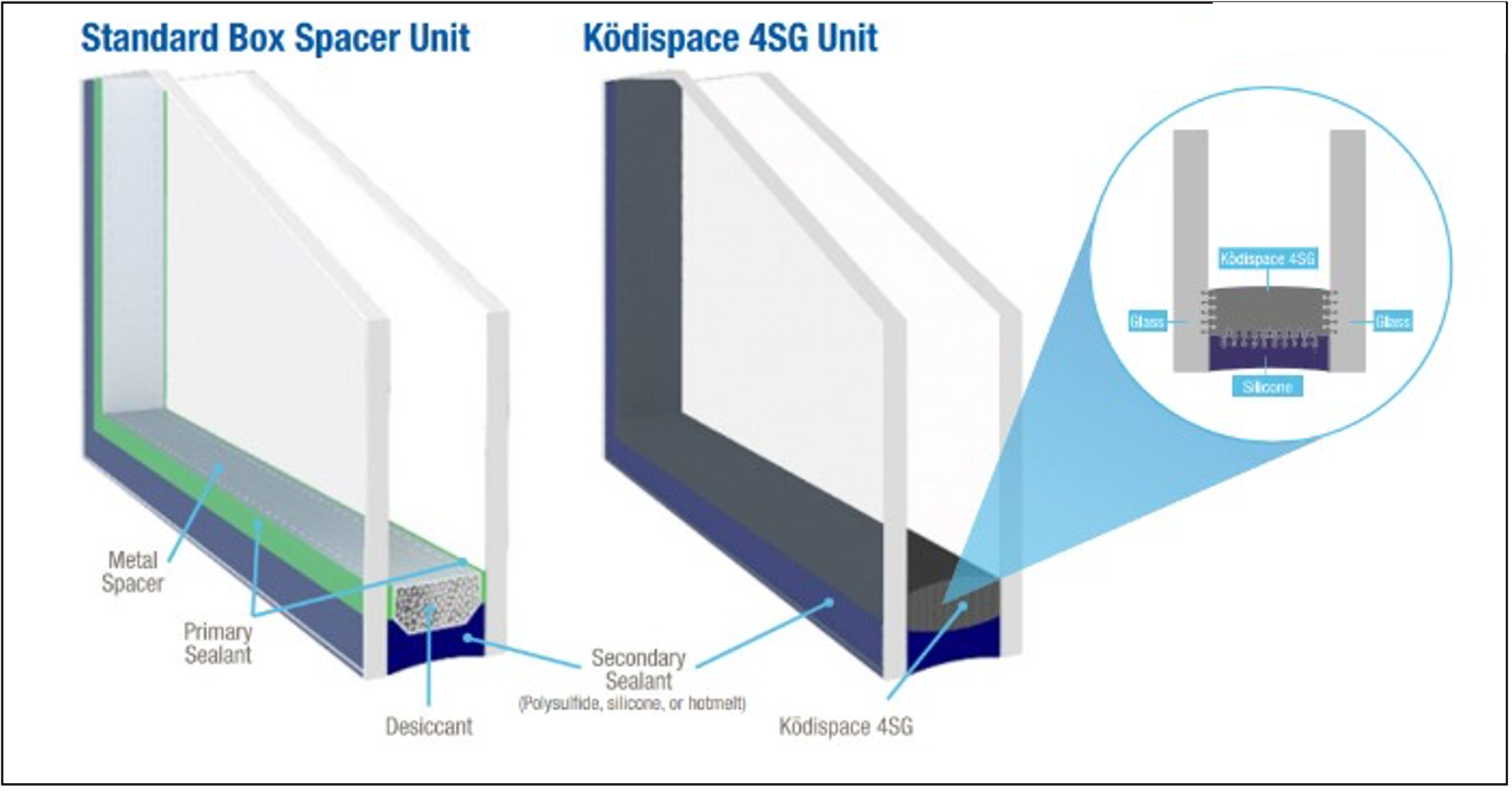
Specialized adhesives and sealants can replace traditional insulating glass assemblies, improving the quality of the final product and the manufacturing process. For example, Ködispace® 4SG® from H.B. Fuller is a one-component sealant that replaces the traditional primary sealant, spacer, and desiccant in one convenient product and can be robotically applied to the glass of an insulating glass unit. Ködispace 4SG also offers superior durability and energy efficiency compared to traditional spacers.
Traditional insulating glass production requires multiple steps—applying the primary sealant, mounting the metal spacer, and filling it with desiccant. In comparison, Ködispace 4SG is automatically dispensed between two panes and chemically bonds to the glass to form a durable yet flexible seal (Figure 1).
Figure 1. Ködispace 4SG vs. Traditional Insulating Glass Assembly.
Replacing multiple, manual steps with a single, automatic step increases production speed, provides consistent application and bonding, and helps manufacturers adapt to labor shortages. The robotic application also supports large-scale, complex projects that would be difficult or near-impossible with traditional insulating glass manufacturing processes.
What the Glass Industry Requires of Adhesives and Sealants
Adhesives and sealants used in glass windows must resist environmental changes, weather events, and pressure from the surrounding building structure. They undergo extensive lab and field testing to ensure reliability and durability in extreme conditions.
When homeowners or business owners run air conditioning units in warm temperature seasons or climates, insulating glass windows must accommodate cold air inside and the warm air outside. Similarly, when temperatures fall and the furnace kicks in, the window must withstand the temperature differences between the warmth inside and the cold outside air. If the adhesives and sealants are inflexible or poorly bonded, they will not be able to function, and, with time, the window will fail.
Materials chosen for adhesives and sealants depend on their end-use. For example, secondary sealants typically are made from silicone, polyurethane, hot melt, and polysulfide. If an adhesive were intended to attach an insulating glass window to a building’s exterior, manufacturers would choose a silicone adhesive because silicone can withstand ultraviolet light (UV) exposure.
How H.B. Fuller Drives Glass Adhesives and Sealants Forward
Choosing the right adhesive for glass windows depends on the application. Consider the following:
Substrates: Choose adhesives capable of bonding dissimilar substrates if you work with differing materials, such as metal and glass.
Strength: Choose adhesives with high bonding strength for high-stress uses, such as glass façades.
Environment: Choose adhesives and sealants capable of withstanding the environmental stressors of the end application (e.g., strong winds, UV exposure).
Production: Choose adhesives and sealants that meet your production line needs, such as fast curing times, flexibility, and the option for automated dispensing.
Choosing the right adhesive is more than picking a product, though. Working with a dedicated, collaborative partner gives glass window manufacturers a competitive advantage. H.B. Fuller supports customers through product selection, development, and implementation so they are getting the best use of their adhesives and sealants. H.B. Fuller chemical engineers and service technicians work closely with customers to:
Tailor formulations to their needs
Perform audits to ensure optimal product use
Provide ongoing consultation and guidance
H.B. Fuller has been advancing the insulating glass industry for decades with innovative technologies like our Intercept® Solutions, designed for high-volume production, and we continue to innovate new solutions aimed at driving improved performance, quality, and sustainability.