
Choosing the Right Adhesive: Electronic Applications
Posted 25 8月 2026 by Jonathan Berry, Electronics Applications & Process Engineering Manager
Imagine you’re at the pool on a hot and sunny day. You lather on sunscreen and then pull out your tablet—only to have it slip from your hands onto the hard pool deck. Instead of having to order a new device, you would likely be able to pick it up, find your e-book or game, and continue relaxing.
Durable consumer electronics that can withstand drops, heat, water ingress, and chemical interactions (e.g., exposure to sunscreen) would not be possible without adhesives. Discover how the adhesives used in everyday electronics help manufacturers meet product design and functionality challenges.
How Adhesives are Used in the Electronics Industry
Adhesives are critical components of many common household electronics, including laptops, tablets, smartphones, continuous glucose monitors (CGMs), and more. Adhesives secure in-vehicle infotainment (IVI) systems—screens displaying information (e.g., time, speed, RPMs, fuel level) and entertainment (e.g., radio stations). They are also used in front- and rear-facing cameras, driver and passenger monitoring systems, and displays built into rearview mirrors.
Adhesives also bond electrical connections to the tiny printed circuit boards (PCBs) used in consumer audio devices, such as earbuds and headphones.
“Basically, everything you and I touch on a day-to-day basis contains adhesives,” says Jonathan Berry, Electronics Applications & Process Engineering Manager, H.B. Fuller.
Printed Circuit Boards Need Adhesives
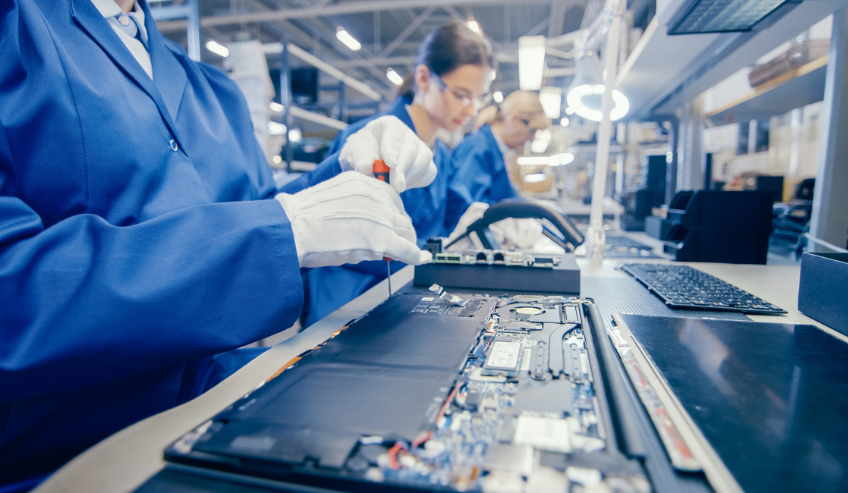
PCBs, the foundational components of electronic devices, also require adhesives to function. Adhesives bond circuit boards to components, such as chips, dies, and sensors. Adhesives also protect and support PCBs and their components and help regulate the temperature within PCBs to prevent overheating, which can reduce processing efficiency. Specific uses include:
Underfills reinforce solder joints and stabilize PCB components.
Corner and edge bonds reinforce the PCB component against drops.
Encapsulants protect PCBs from environmental exposure. Encapsulants are high-reliability materials dispensed onto PCBs.
Conformal coatings also protect PCB components from environmental elements and are optimized for fast processing.
Automotive Electronics Adhesives
For IVI systems, adhesives like reactive hot melts (RHMs) and two-component polyurethanes (PUs) bond the glass or plastic cover protecting the display to the metal frame. Adhesives also bond and secure the components used in cameras throughout a vehicle. For example, a rear-facing camera contains an image sensor and optics that must be aligned. During production, manufacturers dispense ultraviolet light (UV)-curing adhesives or UV- and heat-curing adhesives onto the lens system in a special machine, which then aligns the system at multiple focus points. The adhesive cures to a tight tolerance (±2 microns), ensuring the lens system remains in focus during use.
How Adhesives Benefit Electronic Applications
Achieving the small, lightweight, and powerful electronics today’s consumers expect is not possible solely with mechanical fasteners, such as clips and screws. Electronics manufacturers increasingly use adhesives to secure components in both large and small areas without adding bulk. Adhesives also manage the heat generated by the larger PCBs used in more powerful devices.
Consumer electronics original equipment manufacturers (OEMs) rely on adhesives for high-speed, high-throughput production. OEMs can automate adhesive dispensing to manufacture products accurately and quickly, and adhesives are designed to decrease fixturing time—the time spent holding a component together before it is sent to the next step in the production process. Adhesive manufacturers, such as H.B. Fuller, collaborate with customers to formulate adhesives that cure at precisely the right time during the production process.
Many of the adhesives used in consumer audio electronics are UV- and moisture-cure adhesives. These products enable strong bonds during high-speed production without using heat. The moisture-cure element ensures that adhesives in shadowed areas (areas not exposed to UV light) bond effectively.
What Electronic Applications Require of Adhesives
Consumer electronics are often dropped or spilled on and regularly come into contact with lotions, perfumes, and greasy fingers. Adhesives must maintain a robust, reliable bond despite everyday wear and tear. When it comes to wearables like CGMs and earbuds, adhesives must also be skin-friendly. H.B. Fuller has formulated adhesives that are free from skin-irritating chemicals for use in wearables.
Why Coefficient of Thermal Expansion Matters for Electronics Adhesives
Adhesives used in automotive electronics must have a low coefficient of thermal expansion (CTE) to maintain bonds despite extreme temperature fluctuations. Materials with a low CTE do not expand or contract during temperature increases or decreases.
For example, imagine an IVI system mounted into the dashboard of a vehicle parked in 110°F (43°C) heat. Temperatures inside the car are soaring, causing the plastic display cover to move more than the metal frame encasing the IVI. A low CTE adhesive can accommodate these fluctuations without breaking the bond or the glass used in the IVI. When the owner returns to their car, the system is firmly in place.
Modern IVI displays are increasingly designed with a 3D, curved geometry instead of a flat display. To accommodate the additional dimension, adhesive manufacturers have adapted their dispensing techniques. Adhesive manufacturers must also ensure the design can pass hot and cold thermal shock cycles. Another trend, larger infotainment displays, requires additional strength and flexibility from low-CTE adhesives.
Adjusting Formulations for PCB and CGM Device Production
During PCB production, some OEMs encapsulate specific parts of the board without interfering with other areas. They use a screen-printing technique to quickly, repeatedly, and precisely print an adhesive pattern onto the board, which requires adhesives with precise viscosities. Adhesive manufacturers collaborate with OEMs to formulate adhesives that meet the exacting requirements of screen printing. Working closely with customers is a priority at H.B. Fuller.
“We’re onsite as often as possible to troubleshoot if something goes wrong,” says Conor Mack, Senior Applications Engineer at H.B. Fuller, “That aspect is really important to us. Close communication between on-site support and our R&D department allows us to design adhesives to meet market requirements quickly.”
In another complex situation, an H.B. Fuller project team had to adjust the formulations used in wearables when a commonly used chemical was identified as a skin irritant. Reformulating adhesives to retain the same functionality without this chemical was a challenging yet necessary task that the H.B. Fuller team successfully overcame.
Partnering with H.B. Fuller for Electronics Adhesives
Across the medical, automotive, and consumer electronics industries, significant technological and process needs change yearly. Adhesive manufacturers must remain agile to help customers adapt. H.B. Fuller works closely with electronics customers to develop adhesive solutions tailored to their manufacturing and product challenges.
“We build relationships, are present with customers, and do market valuation and research to understand the industry,” says Berry, “We spend time on market research to be as nimble as our customers are and not just offer cookie-cutter solutions. As our customers evolve, we want to evolve alongside them.”