How to Evaluate Long-Term Adhesion Performance Under Thermal Cycling & Vibration
Posted 10 6月 2026 by Germaine Mariaselvaraj, Technical Supervisor Specialist
Adhesives are a lightweighting marvel for vehicles that must account for every ounce of weight. Adhesives join many different substrates at a fraction of the weight of mechanical fasteners—and have done this reliably for years. But adhesive joints have long-term enemies: vibration and thermal cycling.
Thermal cycling and vibration are real-world challenges for adhesive joints. For example, airplane components must stay functional in the deep cold of the earth’s upper atmosphere and in the hot summer sun on the tarmac. Automobile components must function while rumbling across every pothole. Vibration and thermal cycling both cause wear and tear at a joint, but in different ways. Choosing the right adhesive helps anticipate and mitigate risks from both thermal cycling and vibration.
Start with Failure Modes
Every material and every joint has a failure mode—finding the point of failure is the first step to choosing the right adhesives, and some failure modes are better than others. “There are three types of adhesive failures,” said Mekiyah Bailey, and strategic account manager with H.B. Fuller:
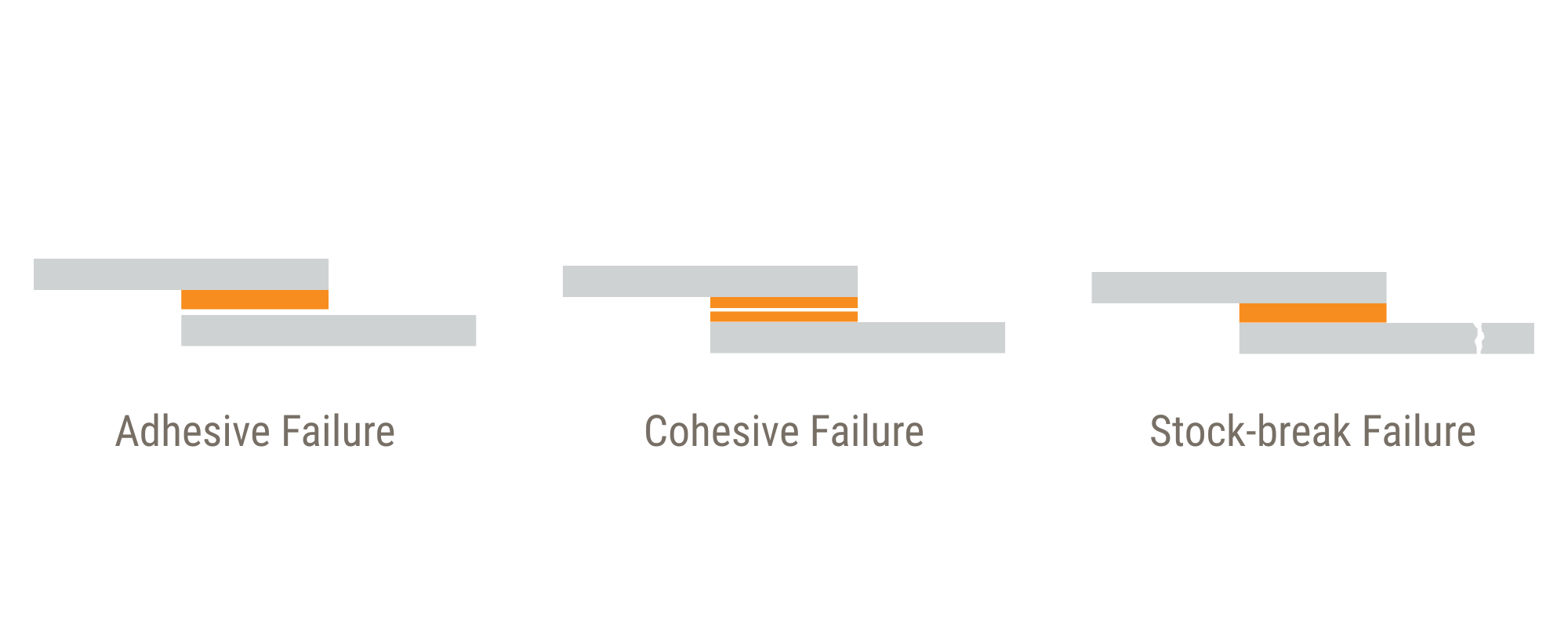
Adhesive failure is a failure to bond to a substrate (Figure 1). When pulling two materials apart, you might find there is no bond between them—the adhesive simply did not stick, leaving no residue.
Figure 1. Three kinds of failure.
Cohesive failure occurs within the adhesive itself. When both substrates—the materials being bonded—can break away while still adhering to each other, that is a cohesive failure. When examining the bond, you would find residue on both substrates. “That’s the best type of failure to have,” said Bailey, “Because it tells you that the adhesive is sticking to the component.” Knowing that the bond with the substrate is stronger than the adhesive’s internal strength is useful information.
Stock failure, or substrate failure, occurs when the adhesive works so well that the substrate fails. For example, stock failure happens when you peel one piece of metal from another piece of metal it has been bonded to. If the metal breaks rather than the adhesive, that is a stock failure.
There are other failure modes, but these three present practical ways to examine how adhesives will perform long-term during thermal cycling and vibration. Examining these failure modes means testing across a series of conditions and from different directions to understand what performs best for your application.
Cool It: Thermal Cycling
Components in an airplane wing may experience temperatures ranging from -55 °C to 125 °C. That is a huge temperature range for even the most robust adhesive. Exploring how adhesives respond to this temperature range begins by reviewing the technical data sheet (TDS) for the desired adhesive’s application and working temperatures. Identify the adhesives that work within the specified range.
Substrates respond to thermal cycling at different rates and with different movements. During thermal cycling, when two substrates have different coefficients of thermal expansion (CTE), the adhesive layer is sheared and stressed at the bondline, again and again. When choosing an adhesive for joining substrates that will experience extreme temperature ranges, it is critical to compare the adhesive’s properties with the materials’ characteristics, and to ask about failure modes for each substrate and the adhesive.
The glass transition temperature (Tg) is another critical factor in choosing an adhesive. A high Tg indicates that the adhesive will perform well as temperatures rise.
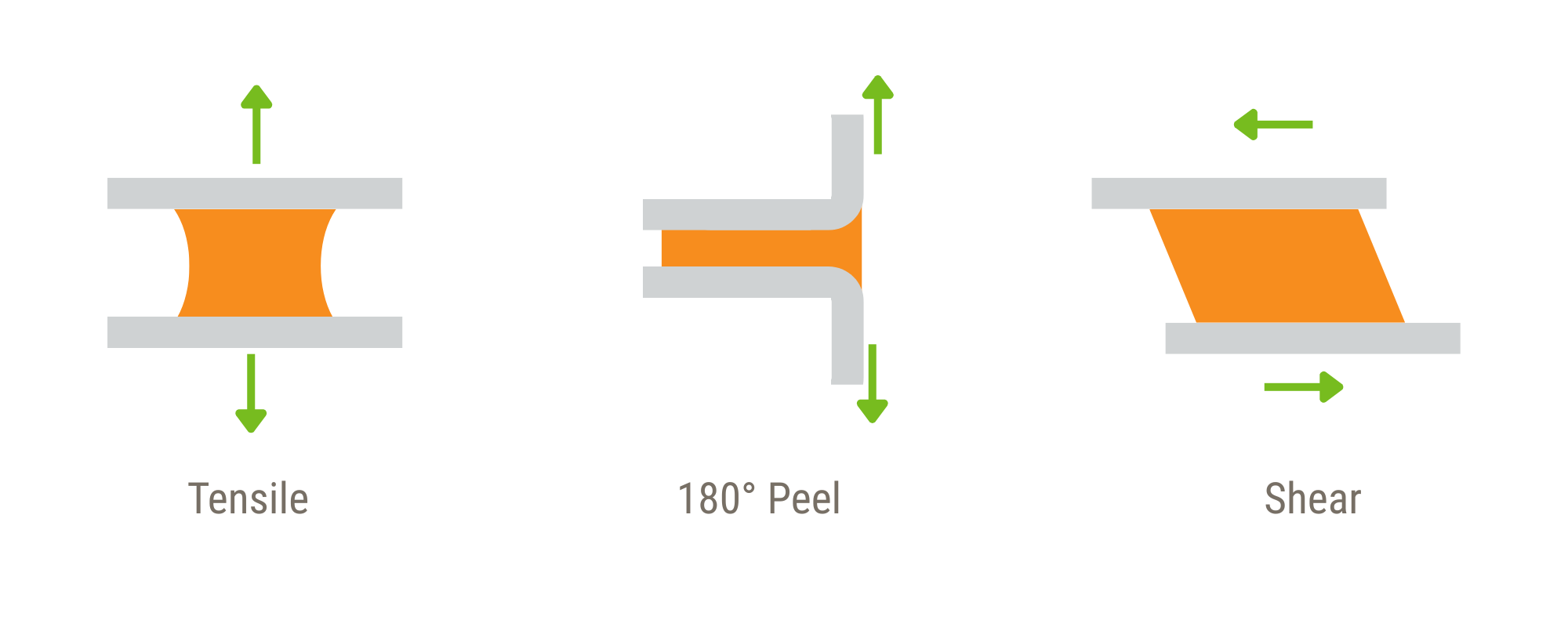
Testing for tensile, shear, and peel strength, which is really testing for different ways of loading stress, will help demonstrate the reality of what the TDS says (Figure 1). Testing along the entire range of working temperatures helps tell the whole story. Accelerated testing methods will help demonstrate how different substrates move through thermal cycling over time.
Figure 2. Common adhesive testing methods.
Tensile Strength and Temperature
The tensile strength of many adhesives follows a predictable curve as temperature varies, with low temperatures (-55 °C to 0 °C) often producing the highest tensile strength (Figure 2). But at those temperatures, adhesives can become brittle.
At room temperature (20 °C to 25 °C), tensile strength is high and usually falls within the range reported by manufacturers. At moderately elevated temperatures (40 °to 80 °C), tensile strength begins to decline gradually. At high temperatures (80 °C to 125 °C), tensile strength can drop dramatically, even by 20-50%.
Shear Strength and Temperature
Shear strength of adhesives depends on bondline thickness, overlap length, and substrate stiffness and material modulus mismatch.
Most adhesives exhibit a gradual reduction in shear strength as temperature rises. This typical pattern is followed by a sharp drop in strength near the Tg. Planning around Tg conditions will be critical to maintaining bonds across the temperature ranges.
Peel Strength and Temperature
Thermal cycling drives fatigue due to repeated CTE mismatch stresses. Microcracks and interfacial cavitation can develop at stress concentrations. Microcracks shift the failure location by propagating along a partially pre-cracked path. This microcrack propagation can reduce the measured peel force and make this failure mode less predictable.
Thermal Cycling Experiments Vs. Computer Modeling
Every company has unique use conditions, which makes it unlikely that engineers can rely entirely on the conditions specified in the TDS. Answering those questions is a matter of experimentation and computer modeling.
Real-world lab testing is a time-honored way to evaluate adhesive performance in changing conditions. Thermal cycling chambers allow for repeated cycles between temperature extremes. Testing is done in accordance with established standards like ASTM D1002 (shear strength), ASTM D638 (tensile), and MIL-STD-810 (environmental/durability).
Computer modeling plays a secondary but still important role in determining adhesives’ failure modes. Finite element analysis (FEA) is particularly useful in calculating where and how stress is brought to bear between different bonded materials. Given that different materials respond to temperature changes differently, FEA precisely calculates where and how severe the stresses are.
“At the end of the day, the customer has to put in all the factors: temperature, geometry, and what materials are being adhered to,” said Germaine Mariaselvaraj, Technical Service Manager at H.B. Fuller. “They have to take all of that into consideration when they input it into their software for the output to be meaningful.”
Shake It Up: Vibration
Vibration brings a different set of stressors to joints and the adhesives that hold them in place. Cyclic stress from millions of dynamic loading cycles (for example, using a universal testing machine) can progressively weaken the adhesion bond. This fatigue debonding can cause adhesive failure, which can initiate cracks that then propagate along the bonded interface. Cohesive failure also shows up as cracks that propagate along the bond due to cyclic movement, which causes the adhesive to become soft or brittle.
Assessing the effects of these dynamic conditions requires fatigue testing, dynamic mechanical analysis, and accelerated vibration testing. Computer modeling can simulate experiments and assist in actual experiments by extending results to conditions that were not physically tested.
Fatigue Testing
Fatigue testing involves applying cyclic stress at known amplitudes and running the tests until failure. This testing is conducted across multiple stress levels, and the results are plotted on an S-N curve. These curves indicate how long a bond survives at a given load level. FEA can predict stress and strain distributions in a bondline under cyclic loading. Since adhesives require material preparations, which must also be measured experimentally, fatigue testing has a strong experimental component.
Dynamic Mechanical Analysis (DMA)
DMA can collect data across a material’s viscoelastic response (that is, the material’s resistance to flow or deformation under stress, the material’s energy storage and stiffness, and the relationship between the elastic and viscous components). These data serve as inputs for the model and allow extrapolation across a wider range than was physically tested.
Accelerated Vibration Testing
Duplicating real-world conditions and compressing them is governed by standards such as IEC 60068-2-6 for environmental testing and MIL-STD-810 (U.S. Military environmental and engineering considerations and laboratory testing).
Our experts can help steer you toward the adhesives that will meet your needs. Because of our expansive portfolio, which includes 10,000 different adhesives, we can also innovate to meet specific thermal-cycling or vibration challenges. In fact, our H.B. Fuller pilot facility in Saint Paul, Minnesota, is a “unique space for scaling up between lab batches to full production,” according to Mariaselvaraj.