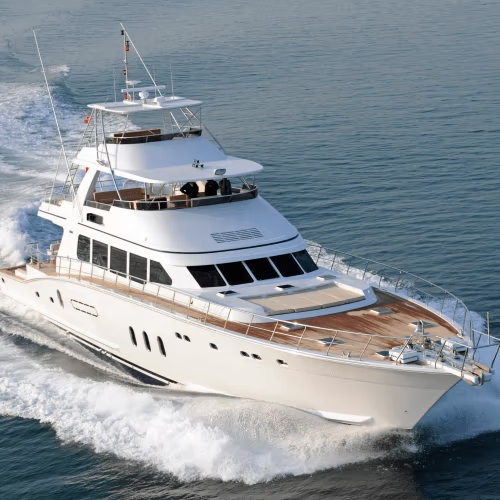
En el exigente entorno marino, los adhesivos y selladores marinos deben resistir la fuerte radiación UV, la humedad, el agua dulce y el agua salada. También es esencial sellar de manera duradera y segura los componentes adicionales en la cubierta y el casco de un barco, así como en el interior, ya que una mala ejecución puede provocar corrosión, filtraciones y daños en el laminado de GRP (plástico o polímero reforzado con fibra de vidrio).
En H.B. Fuller, ofrecemos soluciones óptimas de productos para la construcción de barcos y embarcaciones. Nuestra línea completa de adhesivos y selladores marinos ha sido especialmente desarrollada para satisfacer las necesidades durante la producción y proporcionar estabilidad a largo plazo en el producto final en un amplio conjunto de aplicaciones.
Los proyectos de construcción de barcos y embarcaciones son cada vez más exigentes en términos de aspectos arquitectónicos y de diseño, pero también en cuanto a requisitos técnicos. Para garantizar una aplicación y diseño exitosos, H.B. Fuller proporciona soluciones profesionales para la industria de construcción de barcos y embarcaciones. H.B. Fuller ofrece una gama completa de productos desde una sola fuente: desde la fabricación de vidrios de alta calidad hasta el sellado por debajo de la línea de flotación. Todos los materiales están diseñados para complementarse entre sí. Con estas soluciones de sistema, H.B. Fuller garantiza el más alto nivel de seguridad y calidad en barcos y embarcaciones, desde pequeñas embarcaciones hasta cruceros.
Nuestro portafolio de servicios de adhesivos y sellantes para la industria marina

Pruebas de adhesión

Pruebas de compatibilidad

Capacitación en aplicación en el sitio del procesador

Soporte para trabajar con laboratorios independientes para pruebas externas

Desarrollo de programas de garantía de calidad
Pegado y calafateo de cubiertas
Adhesivos estructurales
Nuestras soluciones se utilizan en diversas aplicaciones marinas, desde paredes, puertas y paneles decorativos hasta revestimientos interiores, placas de piso y techos. Las áreas clave de pegado y sellado incluyen:
• Pegado y sellado exterior: Alta resistencia a los rayos UV y a las condiciones climáticas para fijaciones exteriores
• Pegado interior: Elimina fijaciones mecánicas y ruido, compatible con todos los materiales comunes
Unión, sellado y acristalamiento de ventanas
Las ventanas unidas y los sistemas de fachadas estructurales son cada vez más populares en el diseño moderno de barcos y embarcaciones, ofreciendo libertad arquitectónica y una estética elegante y sin marco que crea una sensación de amplitud. H.B. Fuller proporciona tecnologías avanzadas de unión para vidrio mineral y sintético, incluyendo policarbonato, permitiendo instalaciones duraderas y flexibles.
Las ventanas marinas enfrentan intensos esfuerzos mecánicos, torsión, exposición a rayos UV y condiciones climáticas adversas. Nuestras soluciones de acristalamiento marino—incluyendo adhesivos estructurales, selladores para condiciones climáticas, selladores secundarios y resinas moldeadas—garantizan un rendimiento duradero. Estos selladores protegen contra la intrusión de agua, acomodan la expansión térmica y mantienen la integridad estructural, incluso en entornos con espacio limitado.
Protección de electrónica, encapsulación, altavoces
Amortiguación de sonido
Producción de paneles
Sellado bajo el agua
Frequently Asked Questions (FAQ)
-
What marine applications does H.B. Fuller serve?
H.B. Fuller offers adhesives and sealants for ship and boat building across a broad range of applications, including deck systems, interior bonding and sealing, cabin construction, vessel construction, exterior sealing, below-water sealing, glass bonding, inflatable boats, sound damping, marine electronics, and weld mount adhesively bonded fastener systems.
-
Why is marine adhesive and sealant performance critical?
In the harsh marine environment, adhesives and sealants need to withstand strong UV radiation, humidity, fresh water, and salt water. It is essential to durably and securely seal add-on components on a ship's deck and hull, as well as in the interior, as poor workmanship can lead to corrosion, leakage and damage of the GRP laminate.
-
What is Weld Mount and how does it benefit marine construction?
Weld Mount is an adhesively bonded fastener system designed to remove the need for mechanical fasteners, fixtures, tapping, welding or drilling. Weld Mount fasteners eliminate drilling holes into the core and remove the danger of delamination due to water intrusion. Installation involves cleaning the surface, loading the cartridge, dispensing onto parts, bonding in place (allowing 12-30 minutes for curing), and using.
-
What deck materials can H.B. Fuller adhesives bond?
Decks made from real wood like teak, PVC, or polyurethane are bonded using H.B. Fuller solutions. Depending on the construction of the ship and the type of deck, the company offers the proper system that fits the respective purpose. Decks are bonded over the entire surface to help prevent cavities where water could accumulate.
-
What are the benefits of full-surface deck bonding?
Bonding decks over the entire surface helps prevent cavities where water could accumulate. Deck bonding solutions ensure the deck is slip-resistant, offers insulation both in winter and summer, and protects the substructure from corrosion and solar radiation.
-
How do H.B. Fuller deck caulking products protect marine joints?
H.B. Fuller deck caulking products fulfil the highest requirements when it comes to salt, freshwater, and UV resistance. The joints allow for permanent absorption of movement while simultaneously being easy to process and sand. The bedding compound has both high flexibility and great strength to keep the deck flooring in place while accommodating volume and thermal changes in length caused by temperature differences.
-
What materials are used in inflatable boat construction?
Depending on the type of boat and the usage area, PVC, TPU, chlorosulfonated polyethylene (CSPE) synthetic rubber, or neoprene are bonded. H.B. Fuller inflatable boat adhesives are formulated to bond these materials securely.
-
What performance characteristics do H.B. Fuller inflatable boat adhesives offer?
H.B. Fuller inflatable boat adhesives provide a secure bond that prevents the loss of function and offer resistance to UV, temperature, and hydrolysis, thereby ensuring that the inflatable boat will last for many years.
-
What are marine structural adhesives used for in boat construction?
In modern yachts and boats made from GRP (glass-reinforced plastic) or aluminium, marine structural adhesives are used for deck hull connections, stringer bonding, and the mounting of flying bridge constructions. H.B. Fuller marine structural adhesives offer a strong range of adhesives to bond stringers, ribs, and transoms to reduce weight and noise while lowering costs.
-
How do marine structural adhesives compare to conventional joining methods?
Conventional joining methods such as rivets or screws can result in damage of the thermal insulation or the components through deformation or corrosion. Using marine adhesives and sealants can prevent this and actually both increases rigidity and decreases the weight of the panel. By using H.B. Fuller marine structural adhesives and sealants, vibrations are reduced, different elongations are balanced, and shocks are absorbed.
-
Where are marine structural adhesives applied on boats and ships?
Marine structural bonding adhesives are utilized in many areas in boat and shipbuilding, including walls, doors, decorative panels, interior linings, floor plates, and ceilings. Applications include outside bonding and sealing, bonding and sealing below the water line, and inside bonding and sealing.
-
What exterior bonding and sealing solutions does H.B. Fuller offer?
H.B. Fuller outside applications offer very good resistance against weathering and UV radiation. Many attachments on boats and ships need to be bonded or sealed for design or safety requirements, with these solutions addressing those needs.
-
Why is below-water sealing critical in marine construction?
Attachments below the water line need very strong bonds and tight seals to ensure the integrity of the hull during long periods in the water. H.B. Fuller offers solutions specifically formulated for these demanding below-water applications.
-
What are sandwich and panel adhesives used for in marine applications?
H.B. Fuller's portfolio of sandwich panel adhesives offers a strong range of adhesives to produce sandwich panels and decorative panels made from different materials. Sandwich elements significantly reduce net weight without losing their intrinsic properties. Materials as diverse as wood, metal, plastics or ultramodern composites with a foam or honeycomb core are used in sandwich and panel manufacturing.
-
How do H.B. Fuller marine window bonding and sealing solutions support modern ship design?
On ships, bonded windows enable architectural freedom, modern design and novel types of constructions. H.B. Fuller can bond conventional mineral glass as well as synthetic glass like polycarbonate. On the water, facade systems are subject to strong movements and torsions and must resist strong UV radiation and all types of weather. H.B. Fuller's marine glazing, secondary sealants, cast resins, panel adhesives, and marine weather sealants help realize such complex projects.